People who come across the name 1337x in search results often ask a simple cataloguing question before anything else: what types of content can be found through 1337x, and how is it all arranged? The short answer is that sites of this kind behave less like shops and more like library catalogues for the peer-to-peer world — they point to a wide spread of material, sorted into familiar shelves such as film, television, software, games, music, and books. This overview walks through each shelf, explains the labels attached to individual listings, and looks honestly at why an item’s legal status depends on the item itself rather than on the shelf it sits on.
What a Torrent Index Actually Is
A torrent index is best understood as a searchable directory rather than a warehouse. The site itself does not keep a copy of every film, program, or album it mentions. Instead, uploaders register small descriptor files and magnet references with the index; those descriptors tell BitTorrent software where a file’s pieces can be collected from — namely, from the computers of other people who already have it and are willing to share it onward.
That directory model explains a lot about how these catalogues feel to browse. Because anyone can register an entry, the catalogue grows in whatever direction its uploaders push it. Because the underlying files live on thousands of private machines rather than one server, an entry can linger long after the last person sharing the actual file has switched off. And because entries are contributed rather than curated, two indexes built on the same idea can end up with noticeably different collections.
The Main Shelves at a Glance
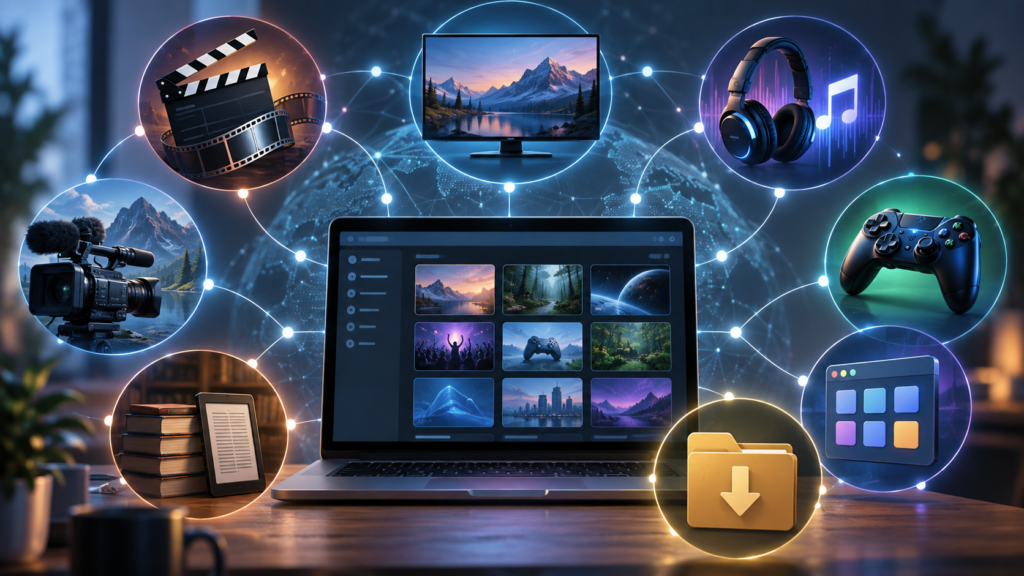
Although layouts differ, indexes of this type settle on a similar set of top-level categories:
- Movies — feature films across genres, eras, and languages
- Television — single episodes, season packs, and complete series
- Software — applications, utilities, and operating system images
- Games — PC releases, console-related material, patches, and modifications
- Music — albums, singles, discographies, concerts, and other audio
- Books and documents — e-books, magazines, manuals, and academic texts
- Courses and educational media — recorded lectures, tutorials, and training material
- Anime and animation — series and films, often with subtitles in several languages
Movies and Television
Film and television are usually the largest and most frequently browsed sections. A single popular title might be represented by dozens of separate entries, because each entry describes a particular copy: standard definition or high definition, compact or large, dubbed or subtitled, sourced from a broadcast, a disc, or a streaming capture.
Listings in these sections normally carry practical metadata alongside the title — running length, file size, language, subtitle availability, and year of release. Television sections are commonly split into individual episodes and bundled season packs, since viewers tend to want one or the other. Older and harder-to-find programmes appear alongside current releases, which is part of the draw: the catalogue reflects what uploaders chose to preserve, not what a licensing department chose to offer this quarter.
Software and Applications
The software shelf covers everything from small single-purpose utilities to full operating system images, office suites, creative tools, and development environments. Entries typically note the version number, the platform, and whether the package is a standard installer or a portable build.
This is also the shelf where the gap between description and reality matters most. A mislabelled media file wastes an evening; an altered program can do real harm, because software runs with broad permissions on the machine that installs it. Nothing in an index entry verifies that a program matches its description or has not been tampered with since leaving its developer — one reason experienced users treat official developer sites and recognised open-source repositories as the default source for anything they intend to install.
Games
Game listings range from current PC releases to older titles kept in circulation by enthusiasts, along with patches, expansion material, and community-made modifications. Entries usually specify the platform, the version, and whether extras are bundled.
Two features distinguish this shelf. First, game files are large, so availability fluctuates sharply — a title is only obtainable while enough participants keep sharing it. Second, games are commercial products with active publishers, so they sit in the same legal territory as commercial software: a store listing, not the index entry, is where legitimate ownership comes from.
Music and Audio
Music sections hold albums, individual tracks, full discographies of long-running artists, live recordings, and spoken-word material such as audiobooks and podcasts. Listings often state the format and bitrate, so listeners can tell a compressed copy from a lossless one.
Music also illustrates how mixed a single shelf can be. Alongside ordinary commercial recordings — which remain the property of their labels and artists — sit public-domain performances, recordings artists have deliberately given away, and releases published under licences that invite redistribution. The category label alone tells you nothing about which kind you are looking at; that judgement has to happen title by title.
Books, Documents, and Courses
The text-based shelves are quieter but substantial: novels and non-fiction e-books, textbooks, technical manuals, magazine back issues, and research papers. Recorded courses — lecture series, language instruction, software training, exam preparation — form a neighbouring section that has grown steadily as video learning has become normal.
Much of this material has a legitimate twin elsewhere: public-domain classics through digital libraries, open-access research through university repositories, openly licensed courseware from the institutions that produced it. The index versions carry no such provenance information — which is precisely the information a careful reader needs.
How Listings Are Organised: Labels and Numbers
Beyond the category shelves, indexes sort and describe entries using a shared vocabulary worth understanding.
Quality labels on video listings describe the source and resolution of a copy — figures such as 720p, 1080p, or 2160p for sharpness, and source tags indicating whether a copy derives from a disc, a broadcast, or a cinema recording. Two entries with the same title and different labels are genuinely different files.
Size and format matter for both quality and practicality: a two-hour film might exist as a 700 MB file or a 20 GB one.
Seeder and leecher counts estimate how many people are sharing a file versus downloading it — the best predictor of whether an entry is alive or abandoned; our explainer on what seeders and leechers are unpacks how those numbers work.
Uploader names and comment threads provide the only reputation signals the catalogue has. They are informal and easy to fake, but a long history attached to a name is still more informative than an anonymous first upload.
Legality Depends on the Item, Not the Shelf
No category on an index is wholly legal or wholly unlawful, because the technology is neutral and the catalogue is mixed. Three broad groups of material coexist in every section:
- Freely shareable material — public-domain works, open-source software, and anything released under a licence or by a creator who permits copying. Sharing this is lawful by design, and peer-to-peer distribution is one of the ways it legitimately travels; our roundup of legal torrent sites collects sources built entirely on this model.
- Commercial material uploaded with permission — some artists, developers, and publishers seed their own work deliberately as a distribution channel.
- Commercial material uploaded without permission — most famous films, games, programs, and books in the catalogue fall here. For these, downloading or resharing copies is an infringement in most countries, though the details — what counts as an offence, what penalties apply, and whether enforcement targets uploaders, downloaders, or both — differ considerably between jurisdictions.
The practical rule is that legality attaches to the specific work and the licence it carries, never to the website or category. A visitor who cannot identify a work’s licence from the listing — which is most of the time — is looking at an unknown, not an implied permission.
A Note on Accuracy and Reliability
Catalogue entries are written by the people who upload them, and nobody at the index verifies each one. Titles get misspelled, episodes get misnumbered, a listing promising one edition delivers another, and files described as complete sometimes are not. Entries also decay: a listing created years ago may describe a file that only one intermittently connected computer still holds.
Keep this in mind when judging the catalogue’s size. A count of listings is a count of descriptions, not of obtainable, accurate, or lawful files — and the distance between those two things is where most disappointment with torrent indexes lives.
Frequently Asked Questions
Why do torrent indexes split everything into categories at all?
Because the catalogue is far too large to browse as one list. Categories mirror the way people search — by medium first, then by title — and they let uploaders attach the right kind of metadata: resolution for video, version numbers for software, bitrate for audio.
What do labels like 1080p or BluRay on a listing actually mean?
They describe the copy, not the work. The number states the vertical resolution of the video, and the source tag states where that copy came from — a retail disc, a television broadcast, a streaming service, or, for the lowest-grade entries, a camera in a cinema. Higher numbers and disc sources generally mean a cleaner picture and a much larger file.
Can the same film appear in an index many times?
Yes, and popular titles usually do. Each entry is a separate copy made by a separate uploader, differing in resolution, file size, language, subtitles, or encoding. There is no single canonical entry, which is why comparing entries — and checking whether anyone is still sharing them — is a normal part of reading these catalogues.
How much of an index do books and courses really make up?
Less than film and television, but more than most people expect. Text files are tiny and cheap to share, so manuals, textbooks, and magazine back issues accumulate in large numbers, and recorded lecture series have become a standard category of their own.
Does being listed in a category mean an item is free to download?
No. A listing records that someone registered a copy with the index; it says nothing about the rights attached to that copy. Some listed works are public domain or openly licensed, many are not, and the entry itself rarely tells you which. Only the licence held by the work’s creator or publisher decides the question.
Conclusion
So, what types of content can be found through 1337x? Practically every kind of digital media that can be copied: films and television in many editions, software and operating system images, games and their modifications, music and spoken audio, books and documents, and recorded courses — all organised into familiar shelves and described with a consistent set of labels covering quality, size, and sharing activity. What that organisation cannot tell you is the thing that matters most: whether a given item is anyone’s to share. That answer lives with each work and its licence, and it changes from one entry to the next.